
Mekong River Cruise
Mekong river
The Mekong
river is one of the world's 10th rivers in its river
length and has great influences upon nature and
societies of the Indochina Peninsula. The name "Mekong"
originates in Thai language, Mae Nam Khong. The source
of the Mekong river is in Tibet mountains and is called
Dza Chu River (River of Rock). After running through
very narrow valley paralling Yangz Jiang and Salween
River, the Mekong reach to Yung-Nan Province of China
and is called Lancang Jiang (Turbulent River). Via
Golden Triangle, the crossing of China, Myanmar and Laos
boarder, the Mekong flow into Vientiane Plain. The term,
Lower Mekong means downstream segment from the point.
There are some notorious rapids for French navigation
plan in colonial period before the Mekong get to
Cambodia, and the last segment is the Mekong Delta in
Viet Nam, which distributes grate influences to
agriculture, especially paddy fields there.
This
complicated flow and relationships between each country
have created specific history and international
relationships of the Mekong river, i.e. many kinds of
problems or frictions related to economy and politics
among the nations. Therefore this river is often called
'The Danube in Asia' due to its difficulty as an
international river. The history of adjustment began
from the Mekong river Committee that organized under
ECAFE of UN in 1957. After the long war period on
Indo-China nations, the committee was reorganized to
interim one without Cambodia and then MRC (Mekong river
Commission) undertake the task independently against UN.
Present members are Vietnam, Thailand, Cambodia, and
Laos followed by China and Myanmar as observers. Now
their biggest theme is sustainable developing of the
Mekong river.
The Mekong
river basin is defined by the land area surrounding all
the streams and rivers that flow into the Mekong river.
This includes parts of China, Myanmar and Viet Nam,
nearly one third of Thailand and most of Cambodia and
Lao PDR. With a total land area of 795 000 square
kilometers, the Mekong river basin is nearly the size of
France and Germany together. From its headwaters
thousands of meters high on the Tibetan Plateau, it
flows through six distinct geographical regions, each
with characteristic features of elevation, topography
and land cover. It would take 2 days of twenty-four hour
driving at 100 km per hour to drive the same distance as
the length of the Mekong river (4800 km).
The most abundant resources in the Mekong basin are
water and biodiversity. Only the Amazon River basin has
greater diversity of plant and animal life. So much
water flows into the mainstream Mekong from the
surrounding basin area that, on average, 15,000 cubic
meters of water passes by every second. In many parts of
the world, that's enough water to supply all the needs
of 100,000 people – the population of a large town – for
a whole day. This water nourishes large tracts of forest
and wetlands which produce building materials, medicines
and food, provides habitats for thousands of species of
plants and animals and supports an inland capture
fishery with an estimated commercial value of US$2
billion dollars per year. Known mineral resources
include tin, copper, iron ore, natural gas, potash, gem
stones and gold.
The Tonle Sap:
During the dry season (March - April), water flows out
from the Great Lake, the Tonle Sap, and joins the Mekong
on its way to the South China Sea. In the wet season
(April - September), so much water flows down the Mekong
that it reverses the flow of the Tonle Sap and the lake
triples in size. This vast floodplain may be the most
productive inland fishery in the world. Its well being
is vital to the people of Cambodia and to the overall
health of the basin. In 1997, UNESCO declared the Tonle
Sap Lake and River System a World Biosphere Reserve.
The Mekong Delta:
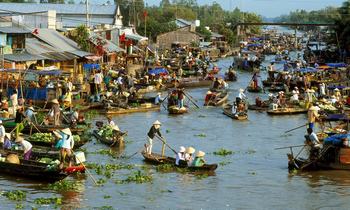
The Mekong Delta is one of the most densely populated
areas on Earth. It is also one of the most productive.
Often referred to as Viet Nam's 'rice bowl', the Delta
produces upwards of 16 million tones of rice annually
for domestic consumption and export in addition to
highly productive shrimp farms, orchards and market
gardens. Maintaining this productivity depends on
understanding and, with the help of upstream neighbors,
dealing with problems of sediment flow, soil salination
and flooding. Every year, annual floods enrich the Delta
soils and bring millions of fish to spawn. Sediments
carried from far upstream replace the land lost through
natural erosion. Without careful management upstream,
flooding will become more frequent and more extreme,
canceling out these benefits and causing millions of
dollars of damage and lost lives. In the dry season,
there must be enough water flowing through the Delta to
prevent the South China Sea from inundating thousands of
hectares of farmland and ruining the soil with salt.
Deep Pools:
At the height of the rainy season, the Mekong river
basin is like a vast fish pond teeming with aquatic
plants and animals in fields and ponds, lakes, streams
and even in roadside ditches. Come April and May, fields
and ponds have dried up, streams have become trickles
and the mainstream itself drops as much as 15 meters.
Researchers have only recently discovered that a number
of valuable fish species have for centuries retreated to
deep stretches of the river to wait out the dry season.
So far, 58 'deep pools' have been identified along one
stretch of river alone (Kratie to Stung Treng in
Cambodia). Very little is known yet about the special
ecological characteristics of deep pools but it seems
clear that deep pools provide important dry season
refuges for valuable species and must be treated as
integral elements of the overall ecosystem.
|